
Aagya Khatri on Nov 04, 2026
Reading Time: 6 Min
On August 26, 2026, devastating flash floods swept through Nepal’s Bhote Koshi–Trishuli river system, damaging power plants, telecommunications networks, roads, bridges, and other essential infrastructure.
According to the United Nations Development Program (UNDP), 11 hydropower stations and one solar plant, representing 431.1 MW of generation capacity, stopped operating following the disaster. Another 15 power projects under construction, with a planned capacity of 470 MW, also suffered damage.
These disruptions highlighted how vulnerable essential infrastructure can be to unexpected events. What happens when the systems, networks, people, or services your business depends on suddenly become unavailable?
Why Business Continuity Planning (BCP) Matters for Tech Companies
Unintended events like floods, earthquakes, power failures, network outages, and hardware failures reveal that even the most advanced technology cannot guarantee uninterrupted operations.
For example, consider a SaaS company serving thousands of customers across multiple countries. Its application runs on cloud infrastructure; development teams rely on remote access, and customers expect the platform to remain available around the clock.
Now imagine its primary cloud region goes down.
Users cannot log in, APIs stop responding, payment transactions fail, and customer support receives hundreds of complaints.
With a strategic BCP, the organization ensures that operations can continue. It is the fundamental purpose of Business Continuity Planning.
What Is Business Continuity Planning?
Business Continuity Planning is a structured process that helps organizations maintain essential operations during unexpected disruptions and restore normal services afterward.
For technology companies, it combines infrastructure resilience, disaster recovery, cybersecurity, risk assessment, incident response, and operational coordination.
BCP addresses three important questions,
- Which business services must continue operating during a disruption?
- What technology, people, and external services do those operations depend on?
- How quickly can the organization restore acceptable service levels if those dependencies fail?
The answers determine how businesses design recovery systems, allocate resources, and establish operational procedures.
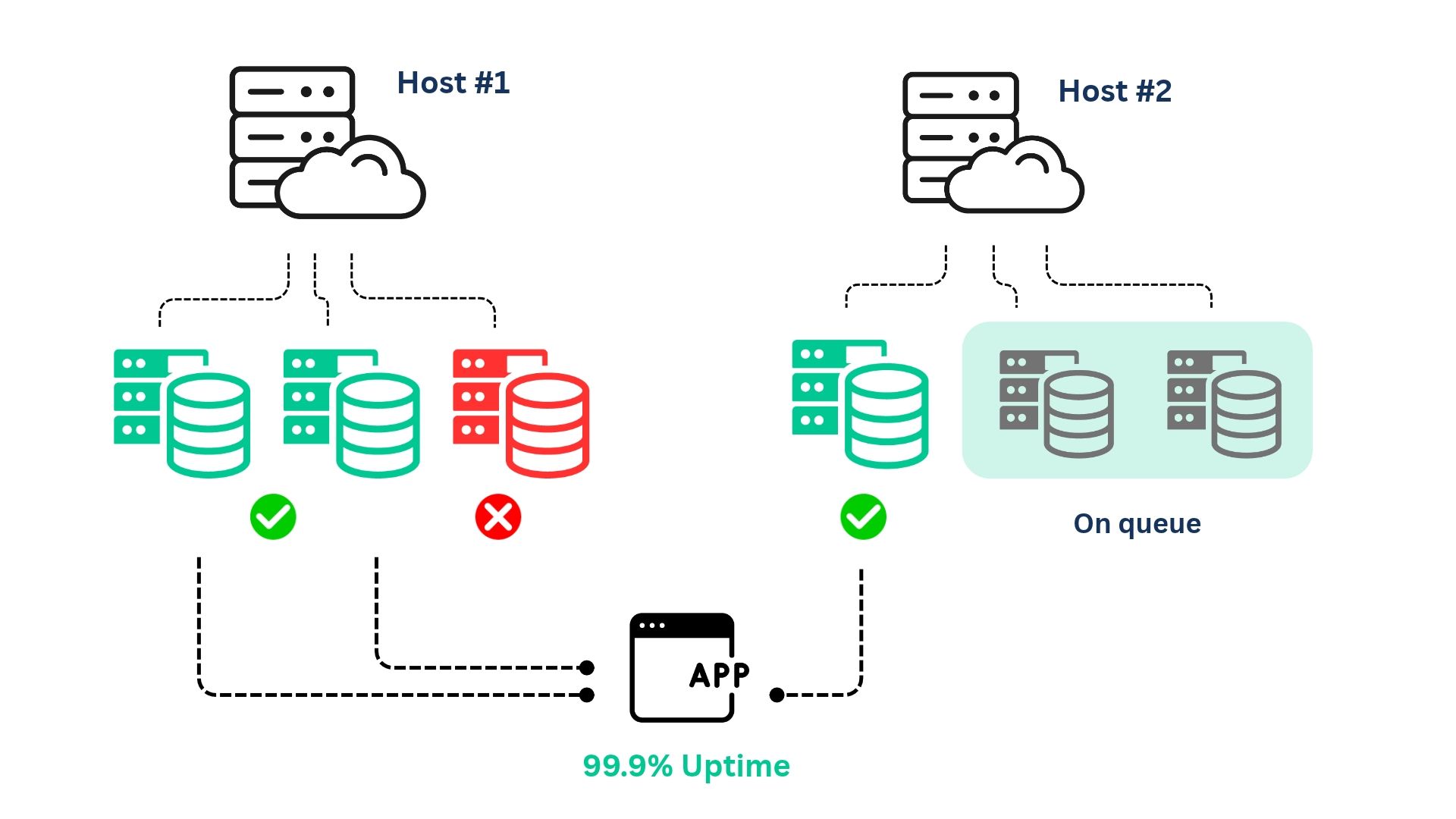
For example, a software development company may consider source code repositories, project management platforms, production environments, and client communication channels essential.
- An e-commerce platform may prioritize checkout services, inventory databases, payment gateways, and order processing APIs.
- A fintech application may require even stricter continuity measures because transaction failures, duplicate processing, or data inconsistency can create serious financial consequences.
BCP must reflect each organization’s specific business risks rather than follow a generic checklist.
BCP vs. Disaster Recovery
Business Continuity Planning and Disaster Recovery (DR) address different parts of operational resilience.
BCP focuses on keeping essential business functions operating. Disaster Recovery focuses specifically on restoring IT systems, applications, infrastructure, and data after a disruption.
Both are necessary because technical recovery alone does not guarantee business continuity.
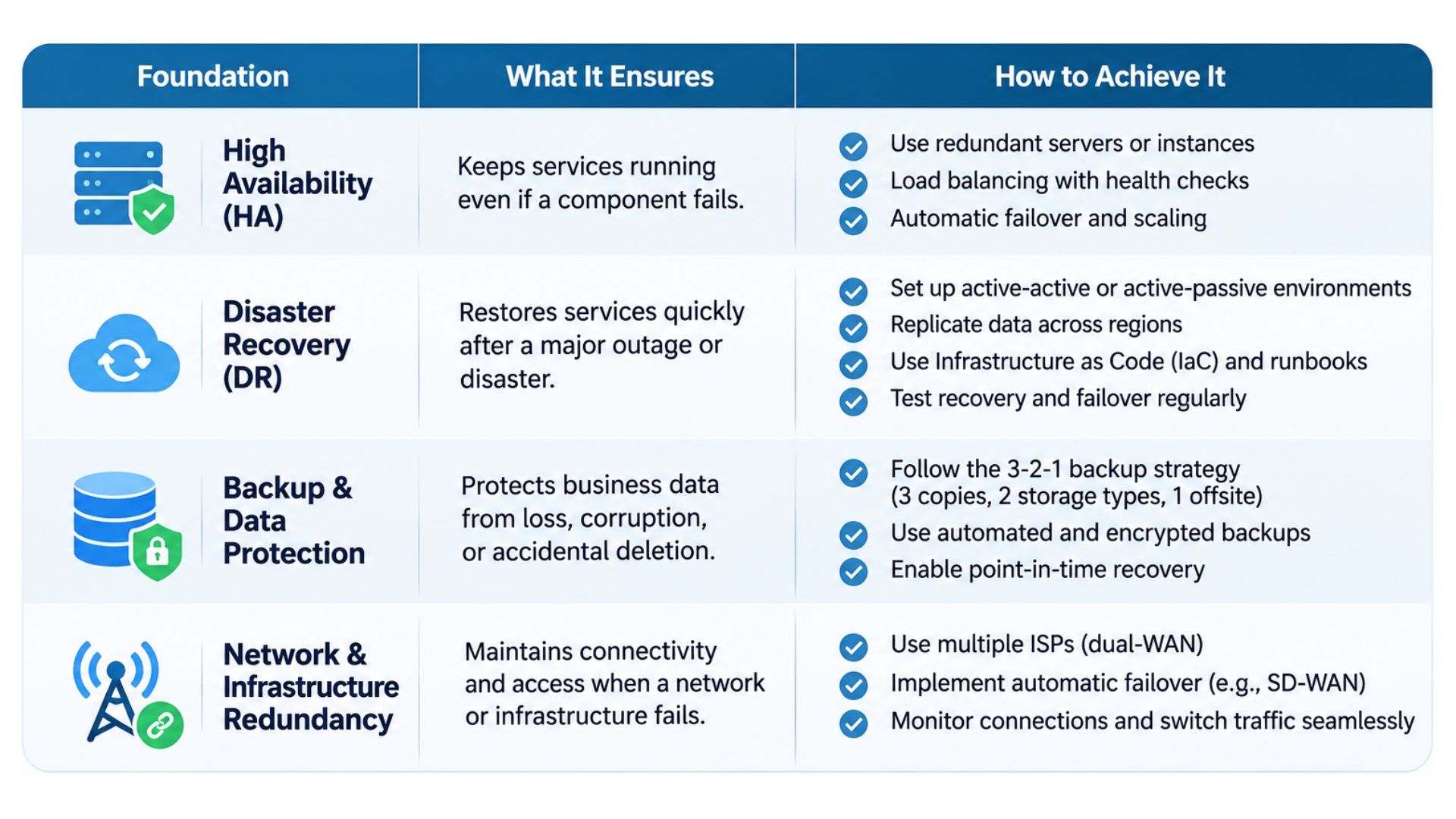
The Four Technical Foundations of Effective BCP
A reliable Business Continuity Plan depends on several interconnected technical capabilities.
1. High Availability (HA)
High Availability is the practice of designing systems to remain operational even when individual components fail.
An application may depend on a single application server, a single database instance, and a single network connection. If the application server crashes, the entire service may become unavailable.
To address this, a high-availability architecture uses redundancy, load balancing, health checks, and automatic failover.
For example, instead of running a Node.js application on one server, a company can deploy multiple application instances across different availability zones. Like,
- A load balancer distributes incoming requests among these instances.
- If one instance becomes unhealthy, the load balancer removes it from the active pool and redirects traffic to the healthy servers.
- Likewise, managed database services can maintain standby replicas and automate failover under supported failure conditions.
However, high availability is not the same as disaster recovery. A multi-zone architecture may still be vulnerable to a region-wide outage, data corruption, or compromised administrative credentials.
Organizations must therefore combine HA with independent recovery capabilities.
2. Disaster Recovery
Disaster Recovery provides the technical procedures and infrastructure necessary to restore services when primary systems become unavailable.
Disaster recovery uses active-active and active-passive deployment models.
- In an active-active architecture, multiple environments actively serve traffic. This improves availability but introduces challenges with database consistency, distributed transactions, and traffic management.
- In an active-passive architecture, the primary environment processes production traffic while a standby environment remains available for recovery.
For many SaaS platforms, a secondary environment with replicated data provides a practical recovery system.
During a major failure, the organization can scale up the standby environment, promote the appropriate database, verify application readiness, and redirect traffic.
A disaster recovery strategy includes,
- Automated database backups and point-in-time recovery
- Cross-region replication
- Standby infrastructure
- Infrastructure as Code
- Recovery automation and documented runbooks
- Periodic backup restoration and failover testing
3. Backup and Data Protection
Backup and recovery design are critical parts of BCP.
A backup creates a separate copy of important business information so that companies can restore it when their original data becomes unavailable, damaged, or accidentally deleted.
However, keeping one backup on the same server as the application is risky. If that server fails or becomes compromised, both the original data and its backup could be lost.
A better approach is the 3-2-1 backup strategy, which recommends keeping three copies of important data, storing them across two different storage types, and maintaining at least one copy at another location.
For example, a SaaS company using MongoDB could maintain automated database backups in the cloud while keeping another encrypted copy in a separate storage environment. If its main database fails, the engineering team can use a suitable backup to restore the affected information.
Companies can also use point-in-time recovery, which allows them to restore a database to a specific moment before an error or failure occurs. This is especially useful when an accidental deletion or software bug damages important records.
4. Network and Infrastructure Redundancy
Network redundancy means having an alternative connection or network path available when the primary connection fails.
For example, instead of depending on one internet provider, a company could use two different ISPs connected through a dual-WAN router or firewall.
If the primary connection fails, the network can automatically switch to the secondary connection, allowing employees to continue working with minimal interruption.
For larger organizations, technologies such as SD-WAN (Software-Defined Wide Area Networking) can help monitor multiple connections and automatically route network traffic through an available link.
Conclusion
For companies working with global clients, trust is built through consistent delivery, reliable operations, and the ability to meet commitments even when unexpected challenges arise. Every project, deadline, and client relationship depends on confidence.
At Searchable Design, we help businesses build resilient, disaster-proof systems with reliable software, DevOps, and cloud solutions.
Comments(0)
Your email address will not be published. Required fields are marked *
Recommended Posts
Unlock the Secret of Power BI to Empower Your Data Analysis
Turn Raw Data into Real-Time Intelligence with Power BI
Why More Startups Are Offshoring Data Engineering Roles in 2026
Unlocking Global Talent for Faster, Smarter, Scalable Growth through Offshoring Data Engineering
How to Empower Your Web Development Project in 2025?
Empowering Your Web Build with the Right Strategy, Stack, and Global Talent Network
RECOMMENDED TOPICS
TAGS
- offshoring
- outsourcing
- remote team
- nepal
- web development
- artificial intelligence
- business process automation
- saas
- app development
- legacy software
- bot
- bot model
- it support
- offshore
- digital marketing
- data analytics
- business continuity
- disaster recovery
- voice search optimization
- seo
- tiktok
- growth hack
- remote engineering
- remote engineers
- cybersecurity
- ai engine
- recommender engine
- development
- sprint planning
- modular app
- cloud based
- api based
- data entry
- api workflow
- engineering team
- service level agreements
- data warehouse
- database
- cloud storage
- engineering
- scalability
- insurtech
- global talent pool
- techical consulting
- power bi
- business intelligence
- backoffice
- communication
- outsource
- it roles
- data engineering
- data engineer
- content development
- business development
- offshore talent
- agentic ai
- insurance
- web security
- project management
- pms
- project management system
- agile methodology
- data
- data centric approach
- customer insight
- it infrastructure
- it sustainability
- cloud computing
- data decision
- off
- test
About
Data Not Found
NEWSLETTER
Related Posts

Choosing Nepal as Your BOT Destination to Create Long-Term Engineering Assets
Quality Talent, Full Ownership, and Massive Cost Savings — The Nepal BOT Advantage

Building an Offshore Team in Nepal: The 90-Days Guidebook
What to expect, avoid, and focus on when building a productive offshore team in Nepal within 90 days