Saramsh Gautam on Oct 06, 2026
Reading Time: 9 Min
Outsourcing often starts with an attractive number. A few months later, you might end up paying more to amend your team, upgrade services, or integrate new tech.
Traditional outsourcing was built for a different era, when “cheap” was the entire pitch. The real cost shows up later: a critical support ticket no one can resolve, a star engineer who vanishes overnight, or a vendor who suddenly owns the leverage in your renewal talks.
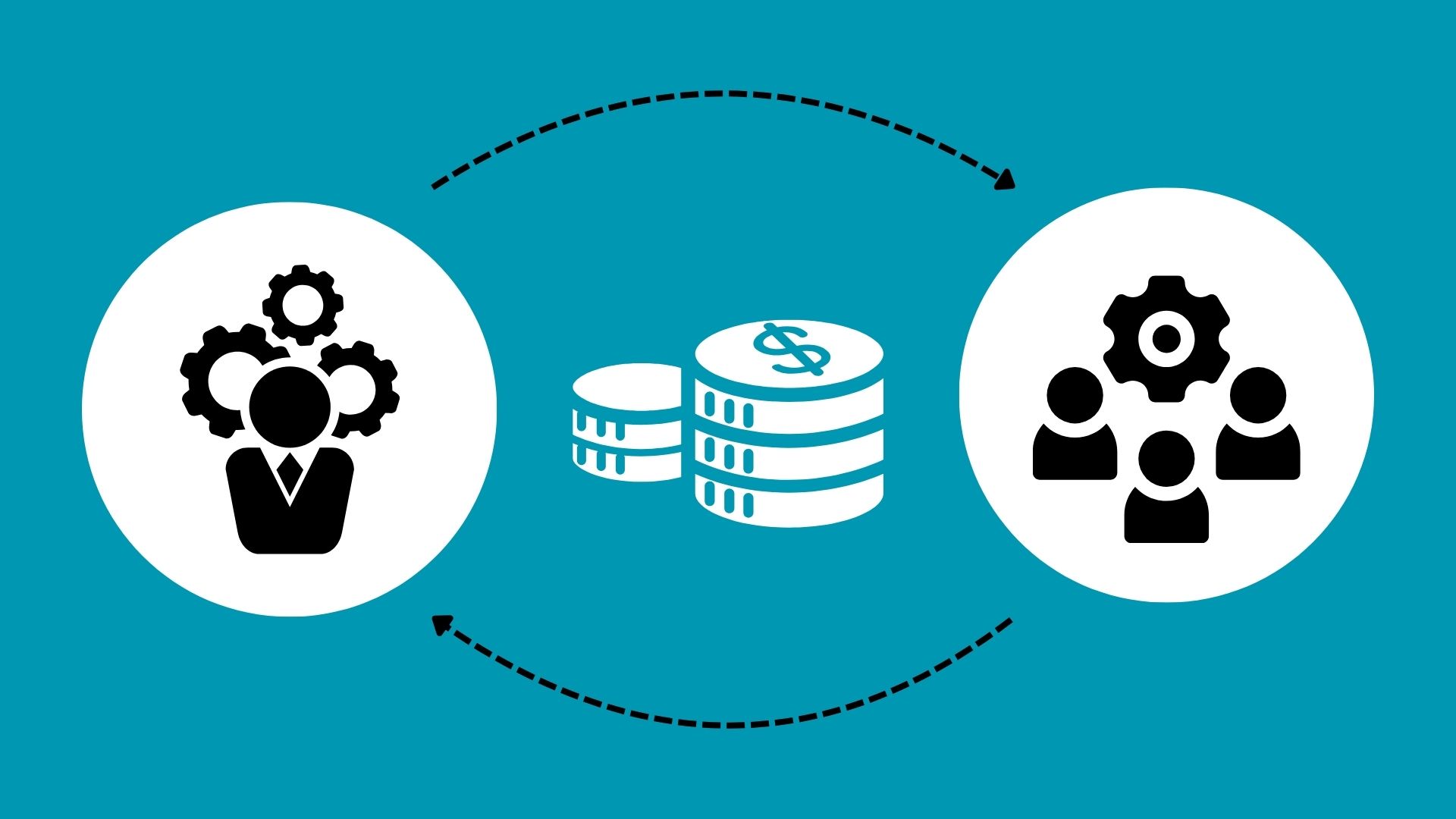
The Build-Operate-Transfer (BOT) model was created to fix those problems. Instead of permanent dependency, BOT lets you build a dedicated team and operation, run it under expert management, then take full ownership back.
Example: A mid-sized SaaS company outsourced its core platform development to cut costs. Two years later they faced skyrocketing change-request fees, key knowledge trapped with the vendor, and almost no internal capability. With a BOT structure they would have stood up the team, stabilized delivery, and taken clean ownership — keeping both the IP and the talent.
Let’s walk through exactly where the money and control leak out in traditional outsourcing, and how BOT plugs those holes.
Solving the Hidden Costs of Outsourcing for Budget-Specific Enterprises
Traditional outsourcing isn't a bad choice, and it can work well for specific projects, specialized skills, or short-term capacity.
But if your goal is to build a long-term offshore engineering team or stay within budget, the BOT model deserves attention.
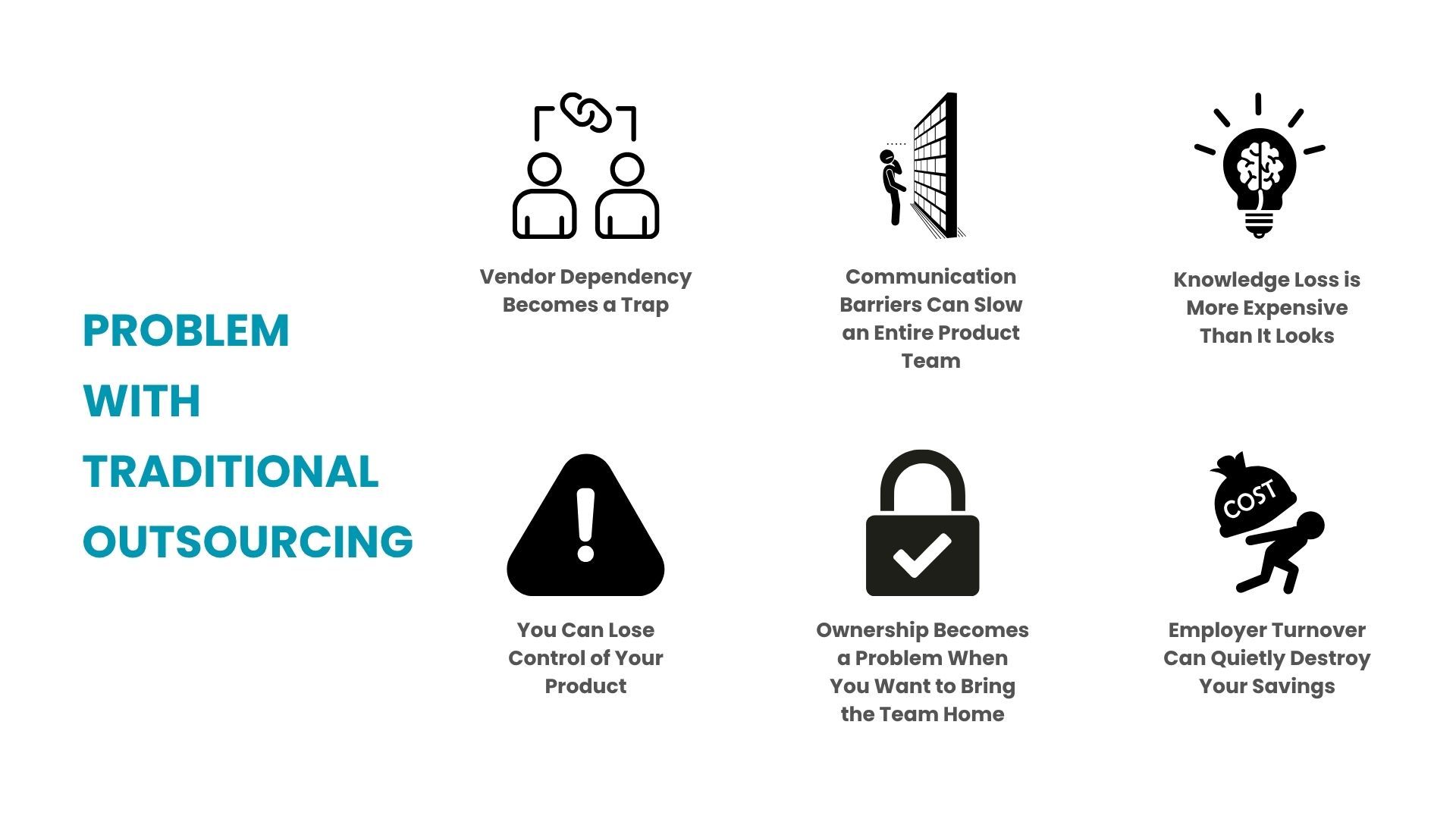
1. Vendor Dependency Becomes a Trap
Imagine your company has worked with the same outsourcing vendor for five years.
The vendor's engineers know your application, understand your architecture, and know why you made certain decisions three years ago.
Your internal team, however, does not have the same depth of knowledge.
Now imagine the vendor increases its rates. What happens?
Changing providers suddenly looks expensive because you are not just changing suppliers. You are changing the people who understand your technology.
This is vendor dependency.
Modern IT sourcing research continues to highlight dependency and lock-in as important outsourcing risks. Gartner's 2026 research specifically recommends managing vendor dependencies and maintaining transition readiness, rather than letting outsourcing relationships become difficult to exit.
The problem becomes even bigger when the vendor controls:
- Technical knowledge
- Documentation
- Infrastructure knowledge
- Development processes
- Key employees
- Historical product decisions
- Your company may own the product. But the vendor may effectively own the knowledge required to operate it.
How BOT Solves This:
A BOT model starts with a different objective. Build your team, not just your project.
The offshore partner helps recruit and establish the team, but the engineers work as a dedicated extension of your organization.
You define:
- Who joins the team
- What they build
- Which technology they use
- How they communicate
- How the team grows
- Over time, the goal is to reduce dependency on the operating partner and increase your control.
2. Knowledge Loss is More Expensive Than It Looks
For instance, a senior developer leaves your outsourcing vendor, and you expect the vendor to replace them.
The replacement may look qualified on paper, but they don't know your system.
Now your existing developers spend weeks explaining architecture, business rules, database relationships, legacy decisions, and customer requirements.
Now, you’re paying for two people while getting the output of one.
This is the hidden cost of knowledge loss.
Knowledge disappears when:
- Documentation is weak
- People change frequently
- Decisions happen outside your organization
- Technical ownership remains with the vendor
- Employees are not connected to the product’s long-term goals
Gartner has also highlighted the risk of losing critical business knowledge when experienced people leave and the importance of structured knowledge-sharing and succession planning.
How BOT Solves This:
With BOT, the offshore team is designed as a long-term capability.
You can establish:
- Shared documentation
- Internal repositories
- Architecture records
- Code ownership
- Knowledge-sharing sessions
- Technical leadership
- Defined onboarding processes
The objective is simple: Your company should become smarter as the team grows, not more dependent on the vendor.
3. Employer Turnover Can Quietly Destroy Your Savings
The sales pitch may say: “You can save 40% on engineering costs.”
But what happens if your offshore team has a high turnover?
Let’s say the vendor needs to replace three experienced developers within six months. Now, your product managers and senior engineers spend time training replacements.
- Productivity falls.
- Deadlines move.
- Code reviews take longer.
- Technical decisions slow down.
- Finally, the original cost advantage starts to disappear.
In fast-moving sectors like IT services, industry turnover averages nearly 25% annually, and nearly half of tech professionals globally are actively job hunting.
Employee turnover creates a chain reaction: Developer leaves → Knowledge disappears → Replacement arrives → Onboarding begins → Productivity drops → Delivery slows.
How BOT Solves This:
A strong BOT structure treats employees as long-term members of the engineering organization.
That can include:
- Career development
- Leadership opportunities
- Training
- Competitive compensation
- Team culture
- Performance management
- Long-term roles
The goal is to build a team that stays in shape.
4. Communication Barriers Can Slow an Entire Product Team
Offshore development is not automatically difficult because of geography. It becomes difficult when communication lacks structure.
Miscommunication can lead to errors, rework, late delivery, or unnecessary work.
But the outsourcing itself isn't at fault. Nothing was technically broken. The process was broken.
How BOT Solves This:
A dedicated offshore engineering center can establish clear communication rules from the beginning.
For example:
- Daily standups
- Shared project management tools
- Written requirements
- Clear acceptance criteria
- Regular sprint reviews
- Technical documentation
- Dedicated overlapping work hours
The goal here is to make the time-zone difference predictable and manageable.
5. You Can Lose Control of Your Product
Traditional outsourcing often revolves around a statement of work.
The vendor receives requirements and produces deliverables. Then the client reviews the results.
This works for defined projects, but product development is rarely that simple.
Modern product roadmaps change constantly: a customer requests a new feature. A security issue appears. A competitor launches something new. All at the same time, sometimes!
The engineering team needs to respond quickly. If every decision must pass through a vendor structure, your development process can become slower.
How BOT Solves This:
With a dedicated BOT team, your company can directly influence:
- Product priorities
- Architecture
- Engineering standards
- Sprint planning
- Code reviews
- Hiring
- Team structure
- With BOT, you’re building an engineering organization around your product.
6. Ownership Becomes a Problem When You Want to Bring the Team Home
This is one of the biggest differences between outsourcing and BOT.
A traditional outsourcing contract often answers: “How long will the vendor provide this service?”
A BOT model asks a different question: “How do we eventually make this capability ours?”
That difference matters.
Imagine your company has spent five years building a successful offshore development operation.
You now want complete ownership.
But:
- Who owns the office and employs developers?
- Who owns the infrastructure and handles local compliance?
- Who manages payroll?
- How will employees transition?
- What happens to existing contracts?
Without a transition plan, the answer may be complicated.
How BOT Solves This:
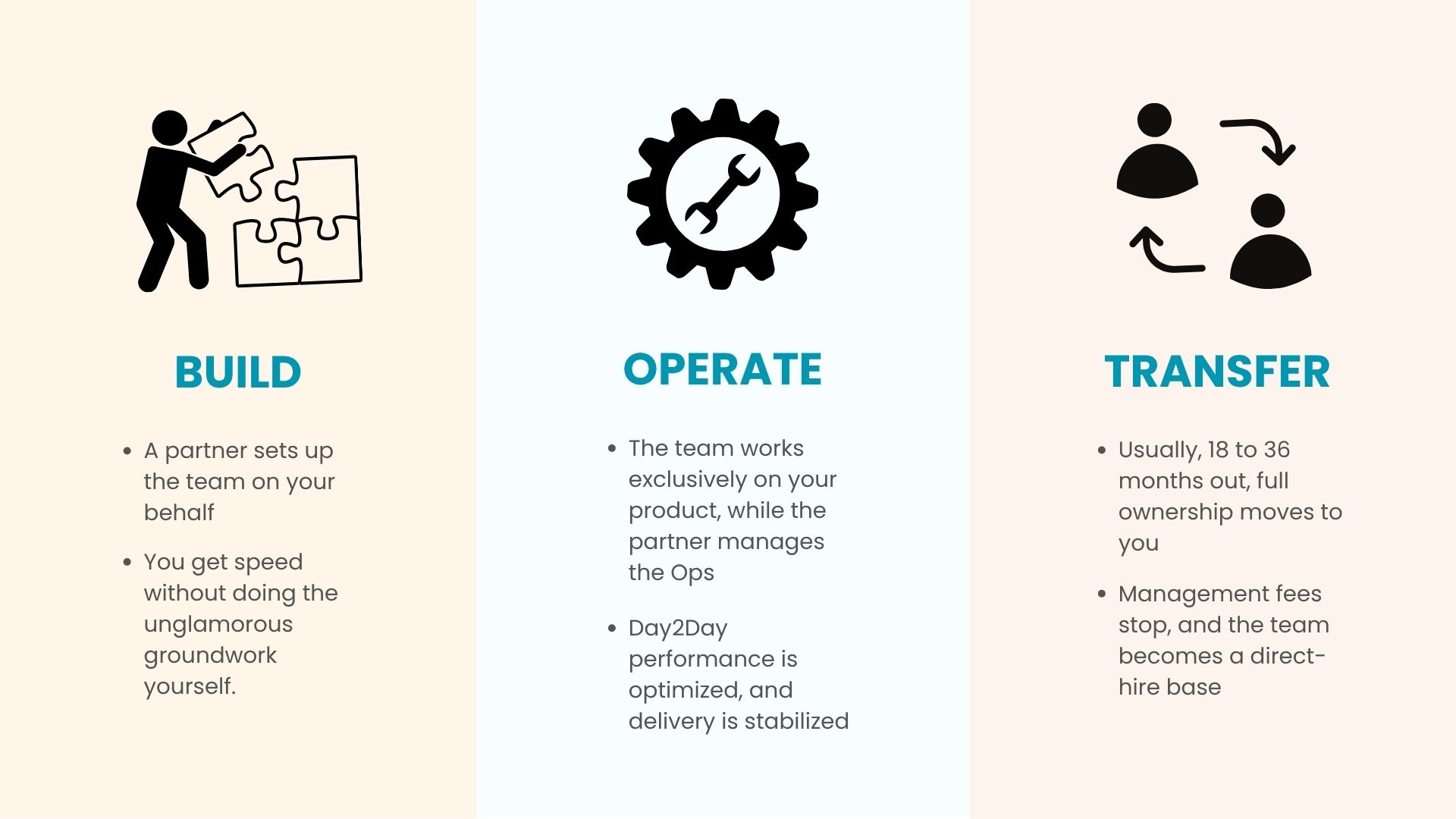
The three stages are straightforward: Build → Operate → Transfer
Firstly, the partner helps build the team and operational foundation. Secondly, the partner manages local complexity during the operating phase.
Then, when the organization is ready, ownership can transition to the client.
This makes the offshore operation an asset that can eventually become part of your company's own structure.
Why the BOT Model Fits Growth-focused Companies
BOT is particularly useful when a company wants more than temporary development capacity. It supports growth by accelerating global expansion and R&D scaling while minimizing upfront capital risk and operational burdens.
Established companies and scaling startups that want to establish an offshore team or captive center with the goal of eventual full ownership can benefit greatly from the BOT model.
Consider a US SaaS company planning to build a 20-person engineering team in Nepal.
Opening a foreign entity immediately means dealing with company registration, payroll, tax administration, office setup, recruitment, HR, compliance, and IT infrastructure, distracting the company from its actual business for a long time.
Instead, a BOT partner can handle much of the local operational work while the American company focuses on building the engineering team.
The company then can decide:
- Which engineers to hire
- Which technologies to use
- How the team works
- What products they build
- How the team grows
The company manages and scales the product and sales; meanwhile, the partner handles the operational foundation.
The Build-Operate-Transfer model exists specifically because these six pain points are common, predictable, and preventable. Instead of renting a team forever, BOT gives you a team on a timeline, with an end date that puts you in charge.
How to Avoid the Hidden Costs of the BOT Model
Searchable Design, a renowned BOT agency in Nepal, has worked with numerous US-based clients. They have shared a few tips on how to avoid burning a hole in your pocket while setting up a BOT team.
| # | Key Area | What to Do |
|---|---|---|
| 1 | Define Ownership | Clearly define ownership of code, documentation, infrastructure, and intellectual property. |
| 2 | Knowledge Sharing | Make documentation and knowledge transfer part of the regular operating process. |
| 3 | Employee Retention | Track turnover, retention, and the reasons employees leave. |
| 4 | Hiring Involvement | Give your team a meaningful role in selecting and hiring engineers. |
| 5 | Exit Strategy | Maintain a transition plan to reduce long-term dependency. |
| 6 | Communication Rules | Set clear expectations for meetings, documentation, response times, and escalation. |
| 7 | Business Outcomes | Measure delivery, quality, reliability, productivity, retention, and product impact. |
Exit Strategy Timeline
| Stage | Timeline | Focus |
|---|---|---|
| Build | 0 Year | Set up the core team |
| Operate | 1–2 Years | Run and scale operations |
| Transfer | 2–3 Years | Prepare for final ownership transition |
Final Thoughts
Traditional outsourcing can reduce the immediate cost of hiring, but it was never designed to serve your long-term interests.
Vendor dependency can limit flexibility, employee turnover can drain knowledge, communication gaps can slow delivery, and weak documentation can create technical risk.
The Build-Operate-Transfer model approaches the problem differently.
More than hiring engineers in another country. It is about building an engineering organization that can eventually become yours.
Searchable Design, with its proficiency and perpetual effort, can help you build a successful and profitable BOT team in Nepal. Consider assessing your team setup cost using a dedicated BOT Calculator.
Comments(0)
Your email address will not be published. Required fields are marked *
Recommended Posts
Unlock the Secret of Power BI to Empower Your Data Analysis
Turn Raw Data into Real-Time Intelligence with Power BI
Why More Startups Are Offshoring Data Engineering Roles in 2026
Unlocking Global Talent for Faster, Smarter, Scalable Growth through Offshoring Data Engineering
How to Empower Your Web Development Project in 2025?
Empowering Your Web Build with the Right Strategy, Stack, and Global Talent Network
RECOMMENDED TOPICS
TAGS
- offshoring
- outsourcing
- remote team
- artificial intelligence
- nepal
- web development
- bot model
- data analytics
- digital marketing
- it support
- business process automation
- offshore
- bot
- legacy software
- saas
- app development
- development
- remote engineering
- recommender engine
- ai engine
- cybersecurity
- growth hack
- tiktok
- seo
- voice search optimization
- engineering team
- sprint planning
- modular app
- cloud based
- api based
- data entry
- api workflow
- service level agreements
- data warehouse
- database
- cloud storage
- engineering
- scalability
- remote engineers
- insurtech
- global talent pool
- techical consulting
- power bi
- business intelligence
- backoffice
- communication
- outsource
- it roles
- data engineering
- data engineer
- content development
- business development
- offshore talent
- agentic ai
- insurance
- web security
- project management
- pms
- project management system
- agile methodology
- data
- data centric approach
- customer insight
- it infrastructure
- it sustainability
- cloud computing
- data decision
- off
- test
About
Data Not Found
NEWSLETTER
Related Posts

How to Empower Your Web Development Project in 2025?
Empowering Your Web Build with the Right Strategy, Stack, and Global Talent Network
Benefits of Technical Consulting in Professional Marketing Strategy
Bridging Innovation and Strategy for Unstoppable Growth