
Aagya Khatri on Jan 02, 2026
Reading Time: 6 Min
Every month, thousands of businesses sign up for new SaaS products—full of hope, demos, and big expectations. Yet most quietly fade away. Not because the product lacked features, but because users never truly connected with it.
A few telltale causes may include confusing onboarding, low feature adoption, and costly manual support that turn promise into frustration.
This is where AI turns frustration into opportunity. AI transforms SaaS from a static tool into an automated platform that guides users, learns behavior, automates work, and delivers insights exactly when they’re needed. Dashboards become conversations. Support becomes proactive. Software becomes a true partner in performance.
Let’s explore how AI converts SaaS from mere software to a functional, time-saving application.
How AI Makes SaaS More Adoptable to Enterprises
One of the most significant problems SaaS solves is complexity, both in operations and in user onboarding.
Traditional SaaS is limited in many ways because it fails to adapt to change. Therefore, many users feel lost during onboarding, the software fails to meet users’ needs, and support teams spend enormous time fixing problems to keep the software up and running.
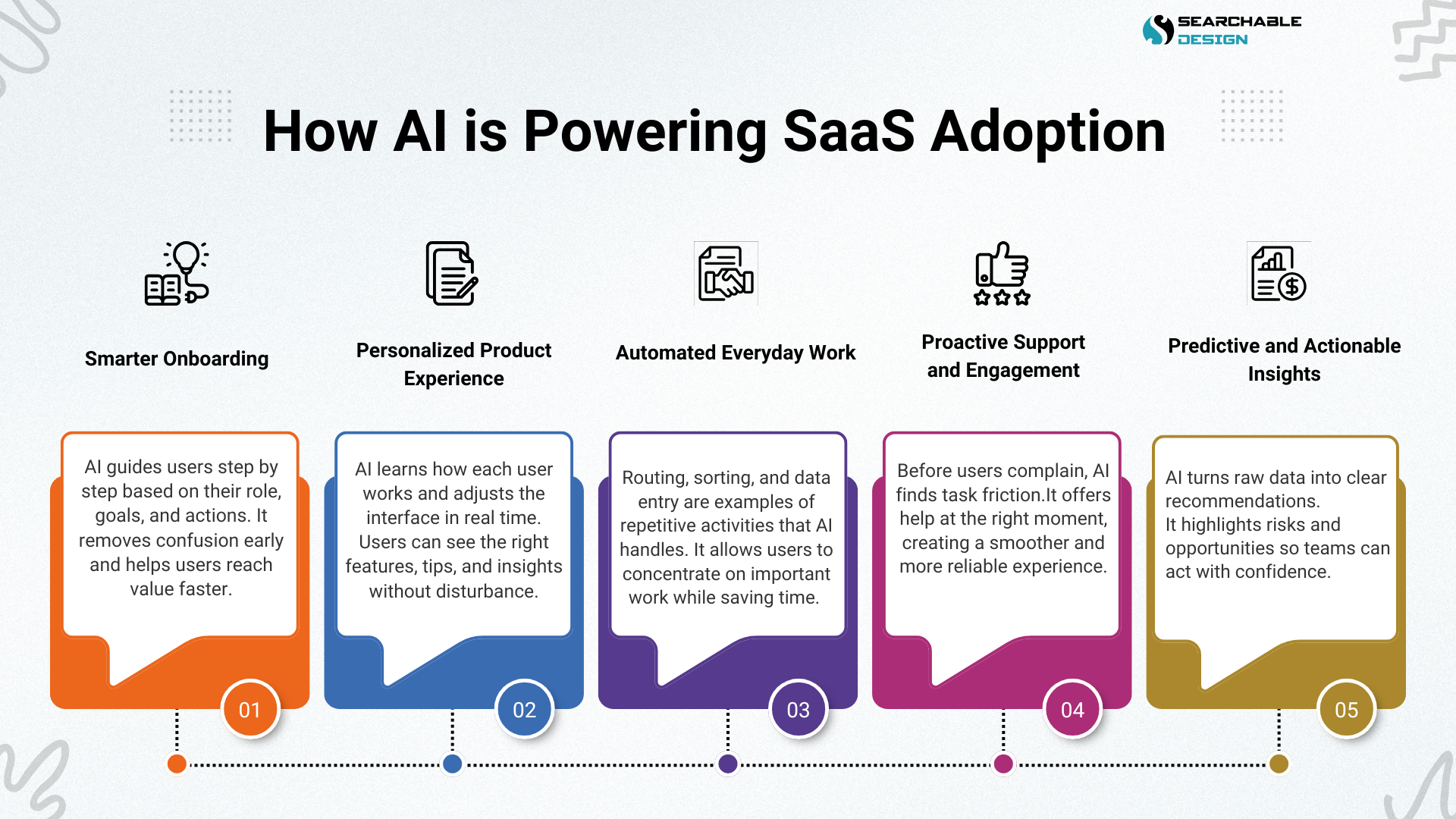
From a user’s view, the product feels easier, faster, and wiser like this,
- Onboarding adapts to each user's needs.
- Data answers questions instead of creating confusion.
- Support shifts from reactive to proactive action.
This is why SaaS needs AI. Not to add more features, but to reduce effort. Not to impress users, but to help them succeed without friction. It also adds intelligence that allows users to do the right thing at the right time without extra effort. Over time, this intelligence builds trust, drives higher customer retention, and enables steady, long-term growth.
1. AI in Personalization, Support, and Engagement
Customer experience plays a significant role in whether people keep using a SaaS product or leave. Traditional support systems, such as static FAQs, long help tickets, and generic onboarding, feel slow and impersonal.
Users today expect quick help, clear guidance, and experiences that match their needs. AI makes this possible.
|
Capability |
What AI Does |
Why It Matters |
|
Instant, Always-Available Support |
AI assistants answer common questions instantly, anytime, without tickets or long wait times. |
Users get help exactly when they need it, reducing frustration and support costs. |
|
Context-Aware Help |
AI understands the user’s current screen, task, or error and provides relevant guidance. |
Support feels natural and precise, not generic or scripted. |
|
Faster Value Realization |
AI guides users to their first meaningful outcome by suggesting subsequent best actions and removing friction. |
Users see value faster, improving onboarding success and adoption. |
|
Early Risk & Churn Detection |
AI monitors usage patterns, errors, and drops in engagement to flag churn risks early. |
Teams can intervene proactively before customers silently disengage. |
|
Smarter Feature Discovery |
AI recommends features based on real usage behavior at the right moment. |
Users unlock more value without feeling overwhelmed by complexity. |
|
Consistent Engagement Over Time |
AI delivers timely nudges, reminders, and insights tailored to user behavior. |
Keeps users engaged long-term with purposeful, helpful interactions. |
2. AI in Workflow Automation for Saas
AI works behind the scenes by automating manual processes, reducing costs, and resolving complex errors, enabling workflows within the product and across teams.
Moreover, AI manages routine operations, continuously monitors systems, and supports more intelligent decision-making. It makes the product more stable, easier to scale, and less expensive to run.
Here’s how AI improves workflow automation and backend performance in SaaS.
|
Benefit |
What AI Does |
Business Impact |
|
Automation of Repetitive Backend Work |
AI handles routine tasks such as data processing, sorting, report generation, and system updates with high accuracy. |
Reduces human error and keeps operations running smoothly. |
|
Faster Product Development |
By eliminating manual workflows, AI frees engineering teams from repetitive maintenance tasks. |
Developers focus more on building features and shipping updates faster. |
|
Predictive System Monitoring |
AI monitors infrastructure and usage patterns to detect issues before they escalate. |
Prevents downtime and improves system reliability. |
|
Lower Operating Costs |
Automated workflows reduce the need for large operational teams. |
Enables efficient growth while controlling costs. |
|
Improved Scalability |
AI automatically adapts systems to handle increasing demand. |
Ensures consistent performance as the user base grows. |
|
Reliable Customer Support |
Stable systems generate fewer outages and support tickets. |
Support teams can focus on user success instead of firefighting issues. |
3. AI-Powered Analytics and Decision Support
Modern SaaS platforms generate large amounts of data from user actions, system events, and business operations.
It includes clicks, feature usage, transactions, response times, and customer behavior over time.
AI actively learns from data using different machine learning models, depending on the SaaS product and the available data.
These models analyze both historical and real-time data, detect meaningful patterns, and translate them into decisions and recommendations.
Here is how AI analytics works in practice across SaaS products
i. Predictive models for business forecasting
For SaaS products such as CRMs, finance tools, and subscription platforms, AI uses regression models and time-series forecasting to predict revenue, renewals, and churn.
These models learn from past transactions, usage frequency, and customer lifecycle data to forecast what is likely to happen next.
ii. Behavioral models for user engagement
Product analytics and collaboration tools use classification and clustering models to group users based on behavior.
These models analyze click paths, feature usage, and session data to identify power users, at-risk users, or inactive accounts.
iii. Anomaly detection for system and usage monitoring
Infrastructure, DevOps, and performance-focused SaaS products use anomaly detection models to monitor logs, latency, error rates, and traffic patterns. These models help to flag unusual behavior early, before users notice a problem.
iv. Recommendation systems for feature and action guidance
Marketing, content, and productivity SaaS platforms use recommendation models to suggest features, workflows, or subsequent actions. These models learn from similar users and historical outcomes to guide users toward higher-value usage.
v. Real-time models for immediate decisions
AI systems process streaming data to trigger alerts or actions instantly.
For example, support and sales SaaS tools use real-time scoring models to prioritize tickets or leads as data arrives.
vi. Scenario and impact models for decision support
Advanced SaaS platforms use simulation and decision-tree models to test “what-if” scenarios.
Users can see how changes in pricing, user behavior, or operational input might affect outcomes before making decisions.
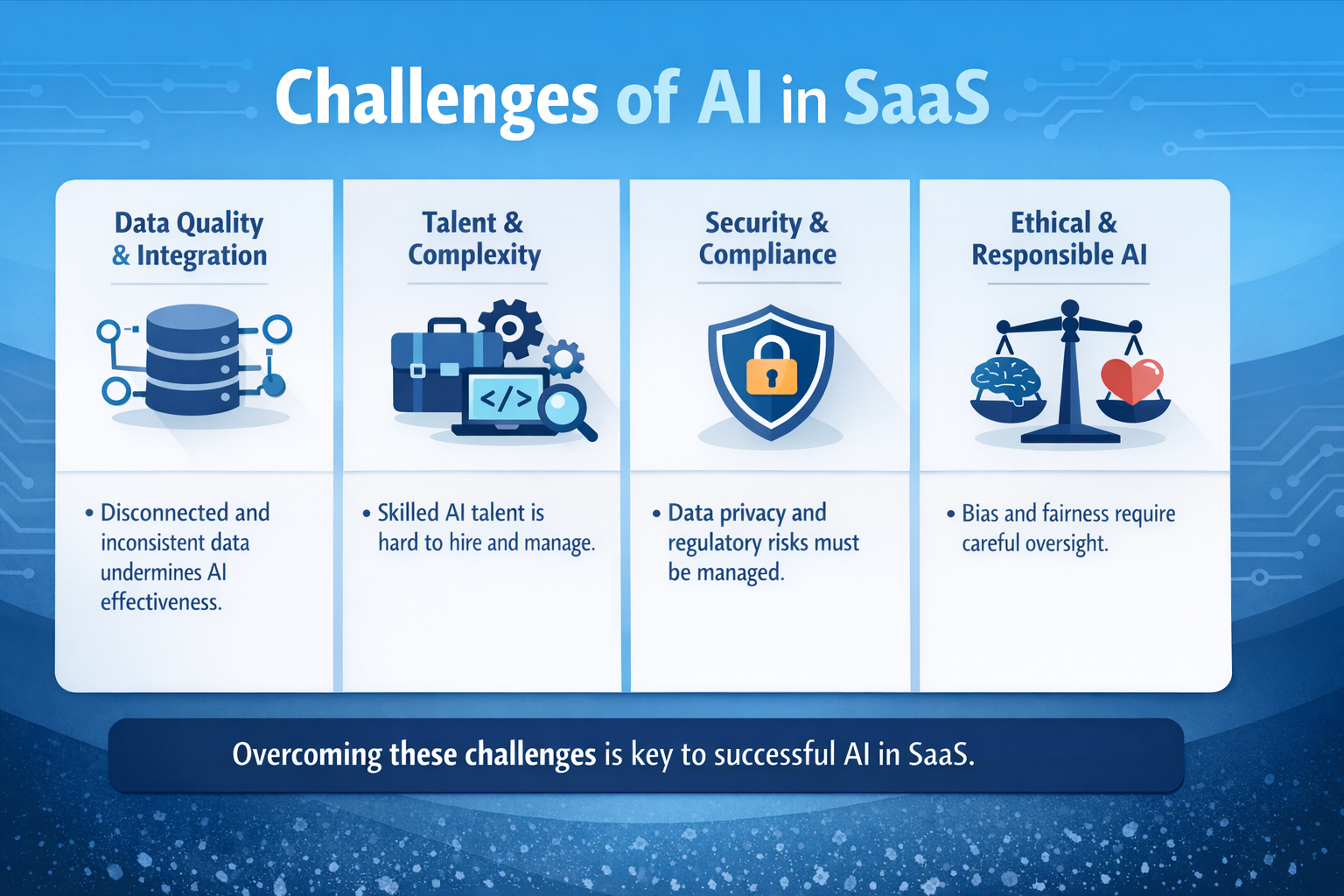
Challenges in AI-Powered SaaS Adoption
AI brings powerful benefits to SaaS, but adoption is not automatic or risk-free.
To succeed, SaaS companies must address several foundational challenges and prepare for how AI will shape the future of software.
Conclusion
In today’s competitive software landscape, AI drives SaaS adoption, performance, and customer success, powering more innovative user experiences, automated workflows, predictive insights, and backend efficiency across the entire SaaS journey.
Ready to build an AI-powered SaaS product that users trust and adopt?
Partner with Searchable Design, the best data-powered web development agency in the USA.
Comments(0)
Your email address will not be published. Required fields are marked *
Recommended Posts
Unlock the Secret of Power BI to Empower Your Data Analysis
Turn Raw Data into Real-Time Intelligence with Power BI
Why More Startups Are Offshoring Data Engineering Roles in 2026
Unlocking Global Talent for Faster, Smarter, Scalable Growth through Offshoring Data Engineering
How to Empower Your Web Development Project in 2025?
Empowering Your Web Build with the Right Strategy, Stack, and Global Talent Network
RECOMMENDED TOPICS
TAGS
- offshoring
- outsourcing
- remote team
- artificial intelligence
- nepal
- web development
- bot model
- data analytics
- digital marketing
- it support
- business process automation
- offshore
- bot
- legacy software
- saas
- app development
- development
- remote engineering
- recommender engine
- ai engine
- cybersecurity
- growth hack
- tiktok
- seo
- voice search optimization
- engineering team
- sprint planning
- modular app
- cloud based
- api based
- data entry
- api workflow
- service level agreements
- data warehouse
- database
- cloud storage
- engineering
- scalability
- remote engineers
- insurtech
- global talent pool
- techical consulting
- power bi
- business intelligence
- backoffice
- communication
- outsource
- it roles
- data engineering
- data engineer
- content development
- business development
- offshore talent
- agentic ai
- insurance
- web security
- project management
- pms
- project management system
- agile methodology
- data
- data centric approach
- customer insight
- it infrastructure
- it sustainability
- cloud computing
- data decision
- off
- test
About
Data Not Found
NEWSLETTER
Related Posts
How to Take Advantage of Agentic AI – Deploying Autonomous Agents to Power Admin Tasks
Turn routine operations into self-managing systems powered by intelligent, adaptive AI agents.
How AI-based Recommender Engine Helps Enterprises Make Smarter Decisions
The AI Secret Behind Amazon & Netflix — Now Available for Your Business