Saramsh Gautam on Jun 11, 2026
Reading Time: 6 Min
PE-backed companies are under constant pressure to cut costs, accelerate growth, and deliver results quickly after acquisition. One major pain point is hiring engineers in the U.S. tech market.
While top-tier senior engineers justify $150K–$250K+ compensation for critical, IP-sensitive work, paying similar rates for mid- and junior-level roles is increasingly hard to justify to boards and investors.
The U.S. faces a severe talent crunch. Software developer jobs are projected to grow 25% by 2032, with wages approaching $200K, yet the domestic supply isn’t keeping up. This leads to long hiring cycles and inflated costs that hurt margins.
The smarter approach: Tap into global talent markets through the Build-Operate-Transfer (BOT) model.
Why BOT Works Well for PE-Backed Firms
|
Build |
Operate |
Transfer |
|
A dedicated team is rapidly assembled to your exact specifications. |
The partner handles recruitment, management, infrastructure, and delivery for 12–36 months. |
You take full ownership of the mature team, processes, and operations. |
This model delivers 50-70% cost savings, much faster ramp-up, and lower risk compared to traditional hiring or outsourcing. It also provides strong IP protection, governance, and a clear path to full control.
For PE portfolio companies needing to scale engineering capacity quickly and efficiently, BOT offers a structured, professional way to build high-performing global teams without the usual headaches.
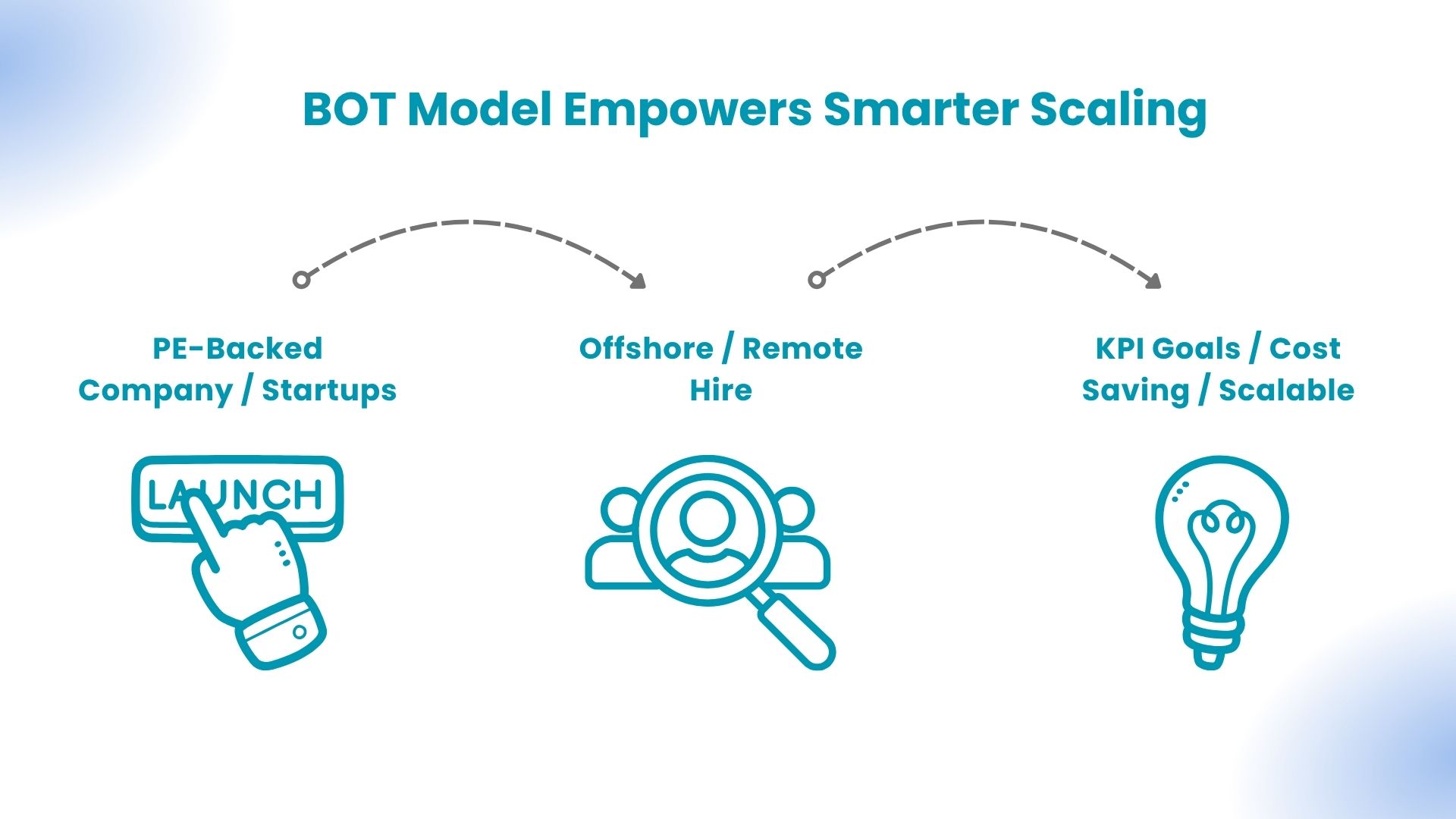
How the BOT Model Empowers Smarter Scaling
Let’s discuss how BOT can work for your portfolio companies.
Phase 1: Build
In the Build phase, the offshore agency takes on full responsibility for recruiting, vetting, and onboarding an engineering team that matches your specific technical requirements within 4-6 weeks, almost half of the US-hiring duration.
They tap into established talent networks, where strong engineering talent is abundant and cost-effective.
The vendor handles all managerial and administrative responsibilities.
Phase 2: Operate
The offshore agency acts as the operational backbone, handling day-to-day management, HR issues, payroll processing, compliance with local labor laws, performance reviews, and team development.
The Operate phase typically lasts 12 to 36 months, depending on the contract structure and the parent company's readiness to absorb the team. However, stay up to date with the remote team governance playbook to keep misunderstandings at bay.
Phase 3: Transfer
After the agreed-upon period, the entire team, along with all contracts, IP, institutional knowledge, and operational infrastructure, transfers directly to you. You become the employer of record, and the vendor steps away.
The result? You now own a mature, high-performing engineering team that's deeply familiar with your systems and culture.
How the BOT Model Helps Solve a PE-Backed Company’s Crisis
Offshoring opens doors to a global talent pool at nearly half the expense to PE-backed businesses competing domestically against trillion-dollar tech giants like Google and Amazon, as well as thousands of well-funded startups.
Markets like India, Nepal, Poland, Romania, Colombia, and the Philippines give you access to millions of qualified engineers where education is rigorous, English proficiency is strong, and compensation expectations are a fraction of U.S. rates.
1. The Cost Saving Mantra
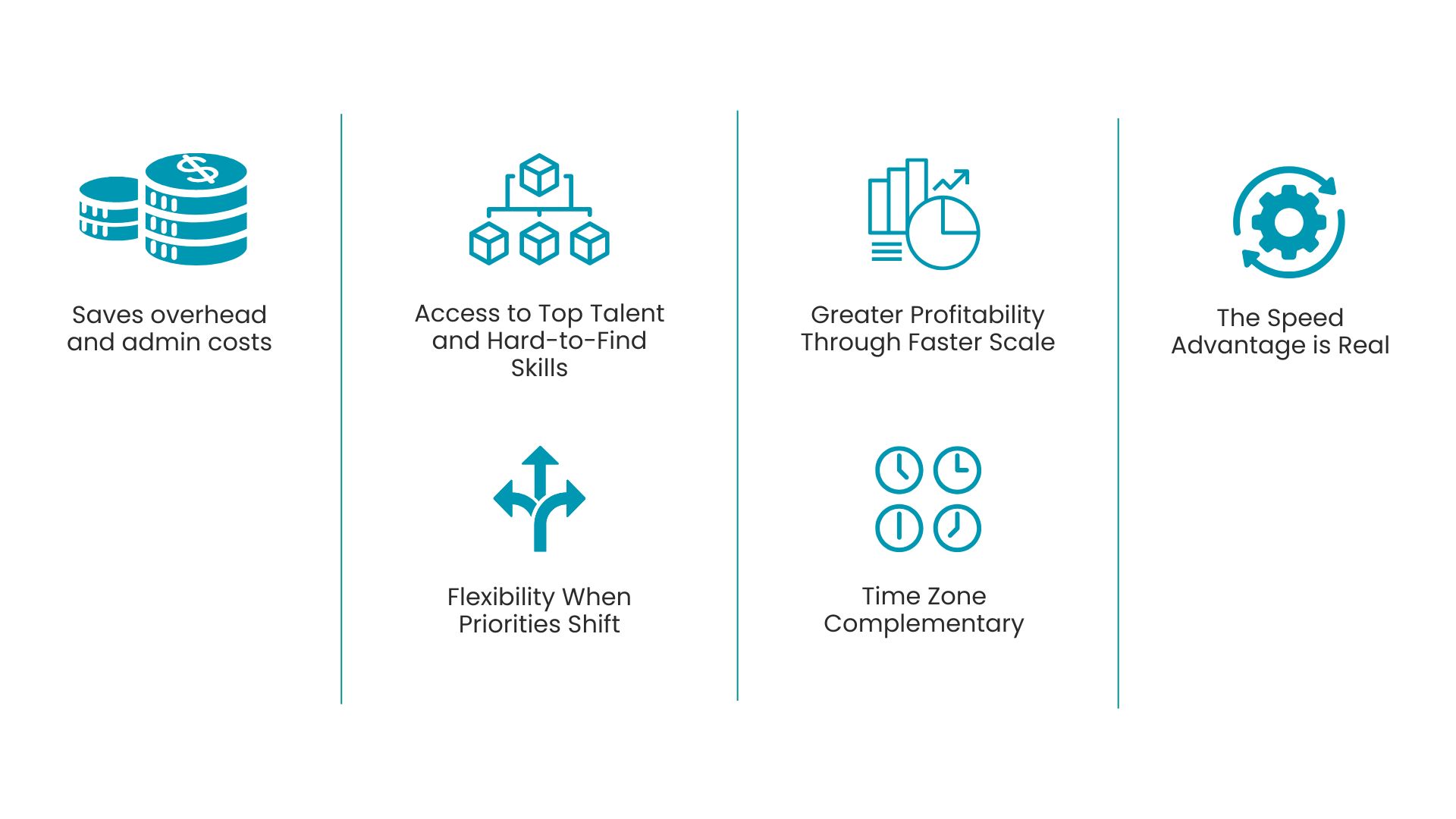
A fully-loaded senior U.S. engineer costs $180,000–$250,000 per year. The offshore equivalent (same skills, same experience) runs $40,000–$80,000 (as per RSESI).
Scale that across a 20-person team and you save $2–4 million annually. Over a 5-year PE hold period, that's a $10–20 million EBITDA contribution before a single extra dollar of revenue is earned.
2. Access to Top Talent and Hard-to-Find Skills
The skills PE-backed companies need most right now are increasingly updated and specialized.
Modernizing legacy systems, automating workflows, building AI and machine learning pipelines, and securing cloud infrastructure aren't just generalist capabilities but deep technical niches where U.S. supply is thin and competition is fierce.
Offshoring solves this by dramatically widening your talent search and tapping into a global pipeline where these skills are abundant and more cost-effective, including full-stack developers, data engineers, and hybrid app developers.
3. Greater Profitability Through Faster Scale
Cost savings are only part of the profitability equation. When you hire offshore, you build your engineering team faster, resulting in a faster product development cycle.
You reach the market sooner, launch features ahead of competitors, and open doors to new markets more quickly.
In a PE environment where every quarter counts, the ability to scale quickly and enter new markets without slowing down is a real, measurable growth lever.
4. The Speed Advantage is Real
U.S. hiring takes an average of 44 days per developer role, according to LinkedIn Talent Solutions, and up to 90 days for senior positions.
A capable offshore partner onboards engineers in 2–4 weeks.
For a PE-backed company running a 100-day transformation plan, that speed difference isn't a minor convenience. It's the margin between hitting your milestones and missing them.
5. Flexibility When Priorities Shift
Market conditions change. Customer needs evolve. Acquisition plans get revised. PE-backed companies can't afford to be locked into a rigid, slow-to-adjust engineering org.
Offshoring gives you the flexibility to scale your team up when growth demands it, scale back when priorities shift, and bring in specialized skills temporarily when a specific project requires.
6. Time Zone Complementary
One underrated advantage of building an offshore engineering team is the round-the-clock productivity enabled by time zone differences when managed well.
Such as when your U.S. engineers log off, your offshore team in Nepal or Eastern Europe picks right up – pushing code, resolving bugs, and moving tickets forward, resulting in a continuous development cycle – a genuine 24/7 engineering engine that domestic-only teams can match.
How to Choose a BOT-Offshoring Partner
The wrong partner costs you time, money, and momentum, all the things PE-backed companies can't afford to lose. Here's what to look for.
|
Talents |
Details |
|
Talent depth in your tech stack |
|
|
Structured governance and communication |
|
|
A clean transfer track record |
|
|
Legal and IP protection |
Your partner should come equipped with SOC 2 and ISO 27001 certifications, clear IP assignment agreements, GDPR and HIPAA compliance, and confidentiality frameworks strong enough to survive PE-level due diligence. |
|
PE ecosystem experience |
Partners who have worked within PE timelines understand the pace, reporting cadence, and relentless focus on value-creation metrics. |
|
Flexibility to scale |
|
Final Thoughts
For too long, PE-backed companies have treated offshoring as a fallback, thinking it’s outdated, which is costing them real value in quality and cost.
However, offshoring under the BOT model is the smartest, fastest, and most cost-effective way to build a high-performing engineering team within a PE hold period.
Contact Searchable Design if you wish to build an economic and highly efficient engineering team.
Comments(0)
Your email address will not be published. Required fields are marked *
Recommended Posts
Unlock the Secret of Power BI to Empower Your Data Analysis
Turn Raw Data into Real-Time Intelligence with Power BI
Why More Startups Are Offshoring Data Engineering Roles in 2026
Unlocking Global Talent for Faster, Smarter, Scalable Growth through Offshoring Data Engineering
How to Empower Your Web Development Project in 2025?
Empowering Your Web Build with the Right Strategy, Stack, and Global Talent Network
RECOMMENDED TOPICS
TAGS
- offshoring
- outsourcing
- web development
- artificial intelligence
- remote team
- offshore
- legacy software
- app development
- saas
- it support
- digital marketing
- data analytics
- business process automation
- seo
- agentic ai
- tiktok
- growth hack
- voice search optimization
- cybersecurity
- ai engine
- recommender engine
- development
- engineering team
- sprint planning
- modular app
- cloud based
- api based
- data entry
- api workflow
- service level agreements
- data warehouse
- database
- cloud storage
- engineering
- bot
- scalability
- bot model
- nepal
- insurtech
- global talent pool
- techical consulting
- power bi
- business intelligence
- backoffice
- communication
- outsource
- it roles
- data engineering
- data engineer
- content development
- business development
- offshore talent
- cloud computing
- insurance
- web security
- project management
- pms
- project management system
- agile methodology
- data
- data centric approach
- customer insight
- it infrastructure
- it sustainability
- data decision
- off
- test
About
Data Not Found
NEWSLETTER
Related Posts

How to Empower Your Web Development Project in 2025?
Empowering Your Web Build with the Right Strategy, Stack, and Global Talent Network
Benefits of Technical Consulting in Professional Marketing Strategy
Bridging Innovation and Strategy for Unstoppable Growth